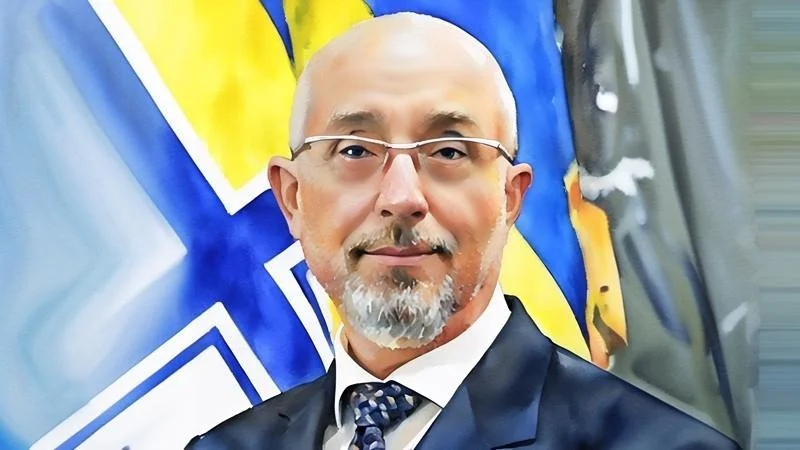
Russian attacks on Ukraine’s energy infrastructure continue as doubts grow that Russia will ever agree to a negotiated peace. Oleksii Reznikov, who served as Ukraine’s defense minister from 2021 to 2023 during the opening phase of the full-scale invasion, argues that victory and peace remain possible.
President Volodymyr Zelenskyy appointed Reznikov defense minister in 2021, three months before Russia launched its full-scale invasion. He previously was deputy mayor of Kyiv and then vice prime minister responsible for reintegration of temporarily occupied territories. He is now chairman and founder of the analytical center Dream Hub, where he works with former colleagues to provide defense and security analysis and advocate for Ukraine internationally.
Reznikov recalls that the earliest months of the invasion tested every assumption. “We understood that we need to fight because we need to survive as a nation, as a state, as a country,” he says. Expectations of foreign nations that Kyiv would fall within days never altered that resolve. Reznikov focused on persuading allies to provide weapons that once seemed unattainable. “Every time I heard, ‘It’s impossible,’” Reznikov says, “it became possible.”
Reznikov helped bring together more than fifty delegations. “We are fighting for the Western world together,” he says. Ukraine’s requests focused on technology, finance, and equipment rather than foreign troops. “Give us the tools. We will do our job,” he said, a refrain that frames Ukraine’s appeals.
Experience negotiating with Russia before the invasion shaped Reznikov’s skepticism toward Moscow. Years spent in the Minsk and Normandy processes taught him that pressure matters. “They will try to cheat you,” he says, arguing that only sustained sanctions and unified Western resolve can compel genuine talks. Democratic societies face challenges in maintaining that pressure, he notes, while autocratic systems exploit hesitation. Stronger sanctions, he argues, remain essential to forcing Russia toward serious negotiations.
Security guarantees are another pillar of Reznikov’s approach. European leaders, he says, increasingly recognize Ukraine as an “eastern shield” for the continent. Investment in Ukraine’s defense aligns with European self-interest, particularly given vulnerabilities along NATO’s eastern flank. Reznikov also supports deeper bilateral arrangements with the United States modeled on existing agreements with allies in Asia and the Middle East. “It’s absolutely doable,” he says, describing such partnerships as critical to long-term stability.
Territorial integrity remains non-negotiable, according to Reznikov. Russian demands that Ukraine formally relinquish occupied regions violate Ukraine’s constitution and public consensus. “Nobody in Ukraine will sign the agreement,” he says. Diplomatic creativity may still offer paths forward, he suggests, citing “constructive ambiguity” as one possible approach drawn from other long-running conflicts.
Despite harsh winters, blackouts, and daily missile threats, Reznikov emphasizes Ukrainian resilience. Civilians adapt through generators, batteries, and ingenuity, he says, while morale remains unbroken. “Without light, without warmth, without heating, without electricity, but without you Russians,” he recalls as a common refrain. Optimism, he says, is a strategic necessity.
Reznikov also challenges assumptions that Russia cannot lose without destabilizing consequences. Such fears, he says, ignore realities already present inside Russia, including demographic pressures, regional instability, and growing dependence on China. Military outcomes now depend less on manpower than on technology, creativity, and adaptability. “It’s not the question of the manpower muscles,” he says, invoking the biblical story of David and Goliath to describe Ukraine’s approach.
“This new year, it’s a real window of opportunity,” Reznikov says, expressing hope that coordinated action between Kyiv, Washington, and European partners can bring peace. Confidence in democratic values underpins his vision. “Democracy will win against autocracy,” Reznikov says, expressing the conviction that continues to guide Ukraine’s fight.