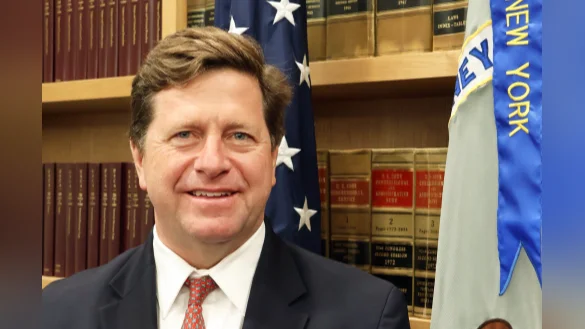
Jay Clayton, U.S. Attorney for the Southern District of New York | Department of Justice
David Smothermon, a former commodities trading executive, was sentenced to three years in prison for wire fraud after admitting to hiding significant trading losses from his employer. The sentencing took place before U.S. District Judge Alvin K. Hellerstein in Manhattan.
According to the U.S. Attorney for the Southern District of New York, Jay Clayton, Smothermon concealed losses and misrepresented his performance, which led to him receiving a $15 million bonus from his company. "David Smothermon engaged in a fraudulent scheme that always ends badly: he concealed trading losses and inflated performance, induced his firm to award him a $15 million bonus, and when the losses were discovered, his firm was devastated," said Clayton. "That devastation cost hundreds of jobs, including in New York. Our Office has no tolerance for insiders who like to enrich themselves at the expense of our fellow New Yorkers."
Court documents show that between December 2015 and September 2016, Smothermon made false entries into the company's accounting system to hide over $240 million in trading losses related to liquefied petroleum gas (LPG) trades. He directed others to alter contract terms so it appeared contracts were more profitable than they actually were.
Smothermon's actions resulted in the company awarding him a large cash bonus. When discrepancies were found by senior executives in August 2016, Smothermon resigned and admitted to mispricing his trading book. The discovery led the company to realize major financial losses and subsequently lay off hundreds of employees.
In addition to prison time, Smothermon received three years of supervised release and must forfeit $11.6 million as well as pay restitution totaling $19,550,081. He paid $8 million toward restitution after pleading guilty and another $300,000 before sentencing.
The Federal Bureau of Investigation conducted the investigation into this case. Assistant U.S. Attorneys Qais Ghafary and Matthew Weinberg are prosecuting the matter on behalf of the Complex Frauds and Cybercrime Unit.