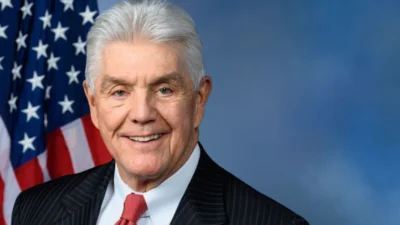
House Armed Services Committee Chairman Mike Rogers addressed the House floor during consideration of S. 1071, the National Defense Authorization Act for Fiscal Year 2026 (FY26 NDAA). In his statement, Rogers emphasized the bipartisan and bicameral nature of the legislation and outlined key reforms and priorities included in the bill.
Rogers highlighted efforts to address issues within the Pentagon’s acquisition process, stating that the FY26 NDAA “includes a series of reforms to put commercial solutions first, eliminate regulatory burdens, end bureaucratic inertia, and put in place a system that will deliver capability to the warfighter at speed and scale.” He added that these changes are intended to ensure U.S. forces remain highly capable.
The chairman also discussed provisions aimed at improving quality of life for military personnel. According to Rogers, “This Bill supports the Trump Administration’s 3.8% pay raise for all servicemembers; authorizes nearly $3 billion for the construction of barracks, family housing, dining facilities, medical facilities, childcare centers, and schools; and improves servicemember access to mental health services.” He noted that enhancing servicemember well-being remains a top priority for the committee.
Addressing global security challenges, particularly those posed by China, Rogers stated: “We need a ready, capable, and lethal fighting force because the threats our nation faces, especially those from China, are more complex and challenging than at any point in the last 40 years.” The bill includes measures designed to strengthen U.S. posture in the Indo-Pacific region such as extending the Pacific Deterrence Initiative and bolstering Taiwan’s defenses.
Rogers further detailed investments authorized by the bill: “This Bill authorizes over–$26 billion in shipbuilding for additional submarines and surface vessels; $38 billion to ensure air dominance with a new generation of fighters; $25 billion to restore America’s arsenal of munitions; and $145 billion to research and develop innovative new technologies our warfighters need to win on future battlefields.”
He concluded his remarks by describing it as “a strong bipartisan bill that delivers for our warfighters and deters our adversaries,” urging members of Congress to support its passage.