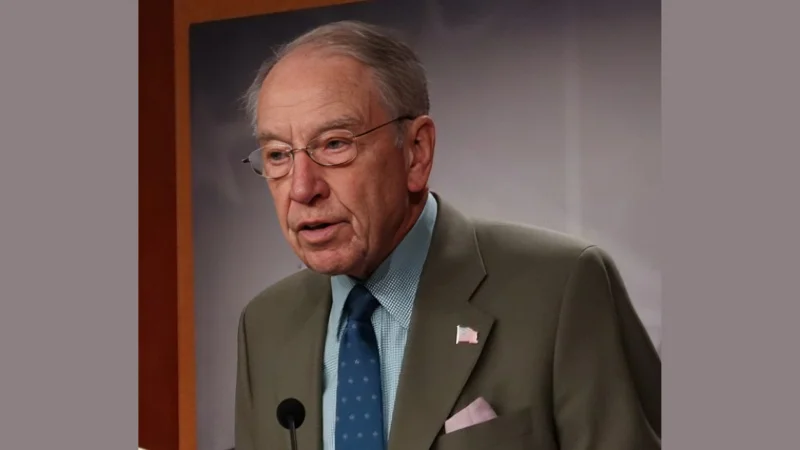
The Senate Judiciary Committee held a hearing to discuss new findings regarding connections between Swiss banks and Nazi-linked accounts. Senator Chuck Grassley of Iowa, chairman of the committee, opened the session by highlighting the bipartisan nature of the investigation and acknowledging the contributions of Ranking Member Durbin and Senator Whitehouse.
"This hearing’s part of my and Senator Whitehouse’s ongoing investigation into Credit Suisse’s historic servicing of Nazi-linked accounts," Grassley stated. He explained that the inquiry began in the previous Congress when he and Senator Whitehouse led the Senate Budget Committee, describing this session as an interim update on their progress.
Grassley recounted how, in March 2020, the Simon Wiesenthal Center informed Credit Suisse about evidence linking the bank to Nazi activities. The bank initially agreed to investigate, hiring a research firm for a forensic review overseen by former Troubled Asset Relief Program Inspector General Neil Barofsky. However, after uncovering damaging information, Credit Suisse limited access to records and terminated Barofsky's involvement.
"The bank cited so-called 'performance issues' for the termination. That was false," Grassley said. "Indeed, if anything, Neil Barofsky performed all too well."
Following these events, Grassley and then-Chairman Whitehouse issued a subpoena—the first from the Budget Committee since 1991—to obtain Barofsky's report for public release. The investigation found that Credit Suisse had not fully reviewed relevant records concerning its Nazi past and had restricted its own review's scope. Despite these limitations, nearly 100 previously undisclosed Nazi-linked accounts were identified; some remained open until the 1990s and one as recently as 2020.
UBS later acquired Credit Suisse and initially revived efforts to investigate these matters by rehiring Barofsky and providing significant resources for research. "But, just like the bank it acquired, UBS snatched defeat from the jaws of victory," Grassley remarked. He noted that UBS began withholding records once it learned about potential public hearings by the committee.
Grassley described how legal action taken by UBS through law firm Gibson Dunn aimed to limit both access to records for investigators and testimony at this hearing. He said: "UBS’s conduct is absurd and a historic shame that’ll outlive today’s hearing."
The hearing also included testimony on forced transfers of Jewish assets and how Credit Suisse allegedly facilitated escape networks—known as ratlines—for Nazis fleeing justice after World War II.
"This investigation has reaffirmed that Swiss banks haven’t historically shown neutrality," Grassley asserted.
The Senate Judiciary Committee plays a key role in overseeing judicial matters nationwide through legislative work and hearings such as this one (official website). It is responsible for upholding constitutional protections, reviewing legislation related to federal law enforcement, evaluating judicial nominations (official website), influencing civil rights policy (official website), and shaping federal law across all states (official website). The committee consists of senators from both parties under leadership from a chairperson who oversees meetings (official website).
In closing his statement addressed directly at UBS representatives present at the hearing, Grassley urged: "To UBS: I strongly urge you to find a way to make peace before it’s too late to repair the damage you’ve done." He also expressed support for Rabbi Cooper from Simon Wiesenthal Center: "there may be rough roads ahead, but I trust you’ll never lose sight of the fact that God isn’t neutral in this fight."