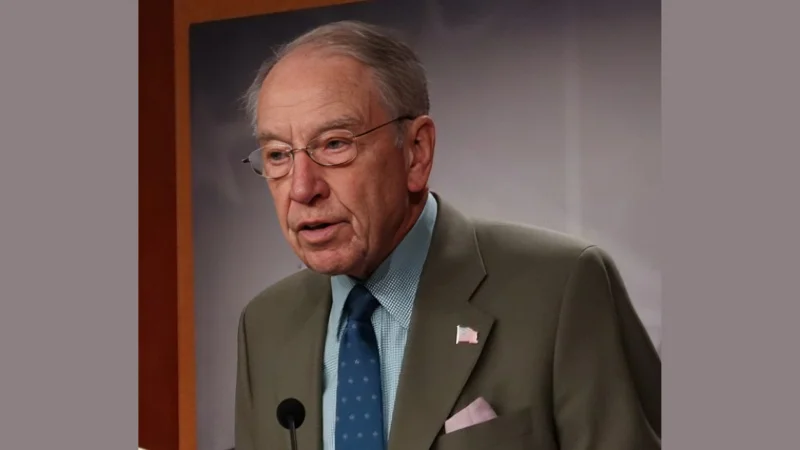
The Senate Judiciary Committee, led by Chairman Chuck Grassley (R-Iowa), held a hearing in Washington to review Swiss banks’ connections to Nazi-linked accounts. The session included updates on the ongoing investigation by Grassley and Sen. Sheldon Whitehouse (D-R.I.) into Credit Suisse’s historical handling of these accounts. Credit Suisse was acquired by UBS in 2023.
Neil Barofsky, the independent ombudsperson investigating Credit Suisse’s ties to Nazi-linked accounts, discussed his progress and highlighted new evidence about forced asset transfers and so-called Nazi ratlines. He also addressed challenges with UBS restricting access to documents needed for the investigation.
Barofsky stated, “The one that hits me the deepest, Mr. Chairman, is the forced transfer of assets… We have descriptions of different ones, examples that we are disclosing for the first time in my testimony. But I can't help but think of the civil servant…. I just can't help but think of that individual saving money bit by bit… and as sort of the horrors of the Holocaust and Nazi Germany in 1930 started to descend, thinking, ‘Okay, I'm going to put my savings in a Swiss bank. That's where it will be safe. That's where I can be sure that even if I don't make it out of this, maybe my kids or my grandchildren can benefit from that money that I saved.’
“I think about what must have gone through these people's minds when they found out that their assets, their life savings, are being plucked from their accounts and delivered to their Nazi oppressors. And I think of [one of] the individuals we talk about: he was boarded on a train to the concentration camp to his eventual murder and [knew] that he had been left penniless at the hands of that Swiss bank.”
Barofsky described difficulties obtaining documents from UBS: “It's essential for me… to have access to all relevant documents. The way [documents are] defined [as] relevant [is if] these are accounts that indicate whether or not a particular Nazi or Nazi-enabler had an account or didn't have an account.
“When I agreed to come back to UBS, we framed our engagement letter in a way to make sure that what happened previously under Credit Suisse could not happen again. And so, our engagement letter makes clear… that we’re entitled to all [relevant] documents.
“To give an example, when this dispute first arose, we gave a set of search terms to the bank, and those search terms were the names of the [Nazi-affiliated] individuals and entities that are referenced in my written testimony. We asked [UBS] to run them against a set of documents that the bank said might be privileged. And there were hits – there were positives. Those are the documents, some of the documents, that are being withheld. We need to have access to that information in order to finish the job.”
UBS representatives Robert Karofsky and Barbara Levi confirmed efforts would be made for transparency within legal limits regarding unredacted names in Barofsky’s final report:
Levi said: “We are working with Mr. Barofsky to try to provide as many names as possible. There are limitations due to Swiss law. However, we don't want to protect any of those names, and we will put our best efforts to provide as many names as possible.”
Rabbi Abraham Cooper from the Simon Wiesenthal Center spoke about accountability for banks involved with Nazis: “Number one… genocides can only take place when you have organization, industry, infrastructure, bureaucracy and access to banks. I think the work and commitment of this Committee – I pray and hope – will help… make sure no one involved in crimes against humanity… would ever be in a position retain those blood-soaked assets.
“Secondly... The Swiss banks – despite their promises over a course of decades… have withheld truth… We need accountability... deal with facts as they emerge...
“Finally... we need...a repository for important documentation... so researchers... future generations can learn from terrible errors...”
The hearing featured testimony from Barofsky; Karofsky; Levi; and Rabbi Cooper.
The Senate Judiciary Committee is responsible for legislative oversight affecting constitutional protections and public safety nationwide through its hearings such as this one (official website). The committee reviews legislation related to federal law enforcement practices (official website) and is chaired by Senator Grassley alongside members from both major parties (official website). Its work influences judicial matters across federal agencies (official website).