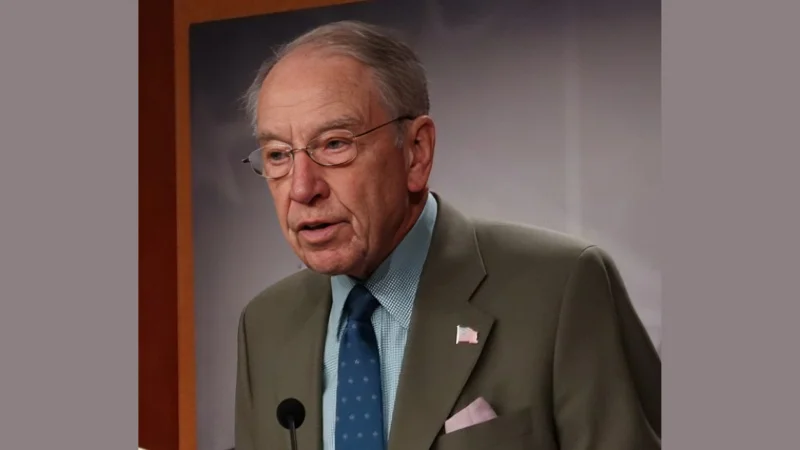
The Government Accountability Project (GAP), a nonpartisan group focused on whistleblower protection, has released a statement supporting the legal rights of whistleblowers who provided Arctic Frost records, including grand jury materials, to U.S. Senate Judiciary Committee Chairman Chuck Grassley.
GAP stated that the right of federal employees to share information with Congress is "unequivocally protected" and cautioned that "branding [the whistleblowers’] disclosure as misconduct could indeed be an invitation to retaliation and create a chilling effect that threatens essential congressional oversight of this and every other Administration."
In a recent Senate floor speech, Grassley criticized what he described as efforts by some media outlets to intimidate or discredit those who disclosed the Arctic Frost records.
Some commentators have suggested these disclosures may have violated laws regarding grand jury secrecy. The information shared was reportedly linked to claims that Special Counsel Jack Smith had conducted surveillance on eight Congressional offices. Critics argue that Justice Department memoranda state such disclosures are not typically protected by the Whistleblower Protection Act due to grand jury secrecy rules, possibly making whistleblowers subject to termination or prosecution.
GAP addressed this concern directly: "As an organization dedicated to protecting lawful whistleblowers, we have to state that the conclusion is incorrect."
The group cited longstanding federal law since 1912, noting: "The right of employees, individually or collectively, to petition Congress or a Member of Congress, or to furnish information to either House of Congress, or to a committee or a member thereof, may not be interfered with or denied." GAP clarified that only classified information is treated differently under separate procedures.
Additionally, GAP pointed out Supreme Court precedent confirming statutory protections for whistleblowers and stated: "With respect to grand jury materials, Congress delegated rulemaking authority to the Supreme Court, but court rules do not override statutory whistleblower free speech protections."
According to GAP: "The right to communicate freely with Congress is essential to effective oversight of Executive branch abuses of power. It is foundational for constitutional checks and balances. For decades, Congress has relied on whistleblowers to expose coverups and misconduct by providing evidence that may not be available to the public. Protecting this channel is critical to ensuring that federal employees understand they have a lawful alternative to silence."
While GAP did not take a position on specific allegations involving the Biden administration due to lack of direct review of evidence, it asserted: "If their concerns were supported by a reasonable belief, these whistleblowers had every right to share the evidence with Congress. This is important because branding their disclosure as misconduct could indeed be an invitation to retaliation and create a chilling effect that threatens essential congressional oversight of this and every other Administration."
GAP added: "Government Accountability Project affirms what we have stood by for nearly 50 years now: the risks of retaliation faced by whistleblowers should never be undermined or doubted. Under every administration, whistleblowers have faced daunting retaliation for speaking truth to power, and for releasing legally valuable information in the name of transparency and to combat fraud, waste and abuse."
The Senate Judiciary Committee plays an important role in national legislative oversight and constitutional protections through its work on judicial matters and public safety policy. The committee reviews legislation affecting civil rights and oversees federal law enforcement agencies; it also evaluates judicial nominations. Led by its chairperson—currently Chuck Grassley—the committee includes members from both major political parties and holds meetings in Washington D.C., where it influences legal affairs across the United States (official website).