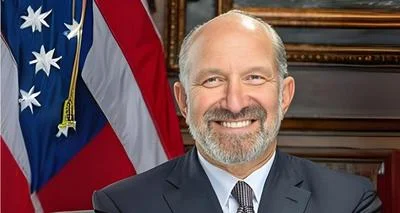
House Armed Services Committee Chairman Mike Rogers addressed the committee during a hearing on U.S. defense policy and posture, focusing on the National Defense Strategy (NDS). The NDS sets direction for force planning, resource allocation, and strategic decisions within the Department of Defense.
Rogers noted progress in key areas of the strategy, including defending U.S. interests in the Western Hemisphere. He cited recent efforts such as securing the southern border and operations targeting narco-terrorist networks. "The southern border is secure; Operation Southern Spear is dismantling narco-terrorist networks; and the historic military operation that brought Nicolas Maduro to justice sent a clear message that the United States will no longer tolerate national security threats in our backyard," Rogers said.
He highlighted rebuilding the Defense Industrial Base as critical for maintaining U.S. strength, which he indicated would be central to upcoming legislation. "This will be a central focus of the FY27 NDAA, because achieving peace through strength depends on reviving America’s arsenal of freedom," he stated.
On deterrence efforts in Asia, Rogers referenced a significant financial commitment: "The One Big Beautiful Bill’s $12 billion investment to improve the readiness of U.S. forces in the Indo-Pacific and strengthen Taiwan’s defense is proof of that commitment."
However, Rogers expressed concern over what he described as deprioritization of U.S. interests in the Middle East within current strategy documents, contrasting it with recent presidential actions against Iran. "That decision underscored the President’s belief that preventing Iran from acquiring a nuclear weapon and expanding its missile arsenal is a core U.S. national interest worth prioritizing," he said regarding Operation Epic Fury.
He also criticized how recent decisions about Ukraine were handled internally and communicated externally: "By the way, Congress and Ukraine learned of your munitions review only after the fact... And not from your team, but from others in the administration who had also been left in the dark and shared our frustration."
Rogers warned that shifting more responsibility to European allies without adequate preparation could create vulnerabilities: "But Europe cannot magically turn that new spending into credible forces and capabilities overnight... This is a recipe to guarantee failure and create a deterrence gap that Russia will exploit."
He further questioned moves such as reducing security cooperation funding for NATO members near Russia's borders and withdrawing troops from Romania without advance consultation with allies or Congress: "Neither Romania nor our other NATO allies were consulted in advance... And while I strongly disagree with the decision itself, advance coordination could have allowed allies to replace the departing brigade to help cover the deterrence gap."
Addressing concerns over communication between defense officials and congressional oversight bodies like his committee—which has jurisdiction under Rule X of House Rules—Rogers said: "We made repeated requests to be consulted on any potential U.S. force posture changes... I am concerned you were not being truthful." He emphasized that effective oversight requires open dialogue rather than relying solely on legislation for accountability.
The House Armed Services Committee oversees programs related to national defense according to its official website (source). The committee influences legislation such as through annual National Defense Authorization Acts (source), includes notable members like Reps. Joe Wilson, Michael R. Turner, Robert J. Wittman (source), operates under specific rules (source), provides congressional oversight for military affairs (source), and is chaired by Rep. Mike Rogers during this Congress (source).
Rogers concluded by stressing bipartisan support for strengthening national security but reiterated concerns about insufficient communication: "Many of us here support the President’s agenda. All of us here want to strengthen our national security. We can’t achieve those goals if we’re left in the dark."