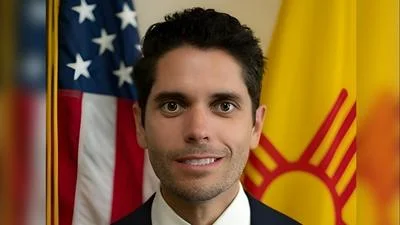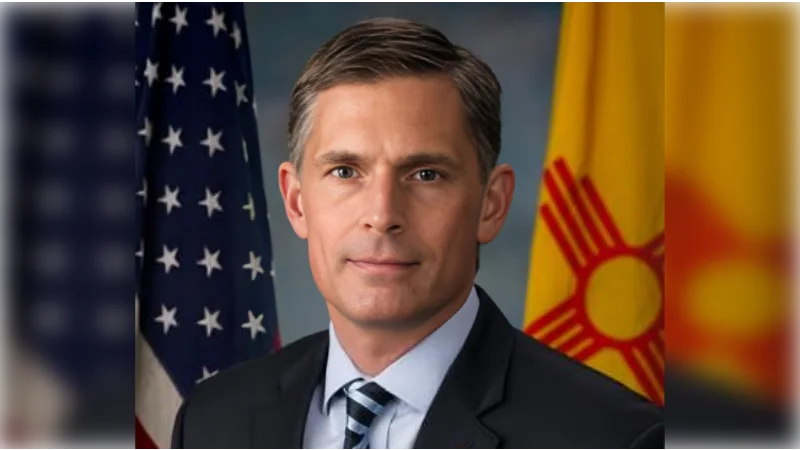
U.S. Senator Martin Heinrich, the Ranking Member of the Senate Energy and Natural Resources Committee, spoke at Semafor’s Principals Live – Powering America’s Future event in Washington, D.C., discussing permitting reform legislation currently before Congress.
During a discussion moderated by Semafor’s Congressional Bureau Chief Burgess Everett, Heinrich addressed bipartisan efforts to advance permitting reform. When asked about working with Senator Mike Lee on this issue, Heinrich said, “I’m optimistic that this is a space where... we're more aligned than maybe some of the other spaces. And so, I think we need to take advantage of that. And I'm a big believer, you know, do what you can, when you can, and don't wait for the perfect moment to suddenly manifest itself. We've got a lot of great foundational work that he and I were both part of in the previous Congress. And so let's build on that.”
Heinrich also criticized actions taken during former President Trump’s administration to halt fully permitted energy projects. He stated, “That's actually something that worries me more than him and I being in different places, on the policies. The dynamic where you have an administration that's willing to do things like issue stop work orders on fully permitted NEPA compliant projects, that's caused a lot of angst in my colleagues... we know things like the offshore wind — Empire and Revolution — and then there's literally a stack of red tape now on Doug Burgum's desk where... he issued a directive that said for 68 different things that are usually handled at a very low level... they all have to go through his desk. And things like right of ways for a solar or wind project, that's a recipe for not building things. And so we have to figure out a way to insert more certainty for both sides and for traditional and new clean generation. Like, how do we make it about whether you check the actual boxes that are relevant to the permit, and you insulate it from the politics?”
On whether legislative solutions could address these concerns if future administrations did not follow them as intended, Heinrich responded: “Well that’s what the courts are for, right? I do think to the extent that we can create law that is more clear, that sets standards instead of allowing for one person's discretion.”
Discussing negotiations over permitting legislation within Congress, Heinrich said talks were ongoing: “We’re not waiting on the House. I think both our teams are figuring out, you know, what's important to the two different caucuses on the committee, and... I hope to be trading paper with Chairman Lee very soon.” He added regarding House proposals: “No, it's not a non-starter. I think anytime the House can move on things it's helpful for the overall dynamic. It's a very different... it's not an analogous permitting reform effort to what our committee is going to do because it's NEPA-centric.” On whether Senate proposals would be broader than those from other committees: “It would, but the NEPA stuff also lives at EPW. It’s in a different committee... speed is not necessarily analogous to the things that we would work on in the Energy and Natural Resources Committee, like geothermal that Chairman Lee talked about and transmission and those things.”
Heinrich emphasized urgency around building new energy infrastructure: “I think that's a real dynamic. I mean, as a country, we need to be able to build big things. And to use an example that I worked on… I worked on a transmission project… when I got to the House of Representatives in 2009. It’s being energized right now. Seventeen years. That’s not functional… Now it's a great project… injecting… tens of billions of dollars into the economies of New Mexico and Arizona. It's the largest clean energy project ever built in the Western Hemisphere. But come on… nobody’s that patient.”
Asked if Democrats had historically been resistant to speeding up such projects: “I think the times have changed… my party feels a sense of urgency that was not shared by… colleagues in the past.” On shifting attitudes: “It’s kind of both… people realize whether you want to solve for climate or whether you want to solve for AI… we have to be able to build stuff.… if you look at pipeline right now of new generation onto grid because of price 95% of it is actually clean energy.… if all gets hung up in permitting process or on somebody's desk… we're not going win AI race.”
Regarding relationships with federal agencies crucial for New Mexico's interests—such as public lands and national laboratories—Heinrich said he maintains contact with agency heads: “He takes my calls,” referring specifically to Secretary of Interior.
On AI data centers’ impact on communities nationwide and local concerns over resources such as water consumption: “I think that a lot of AI developers are not experienced in this state… they're making a lot mistakes out gate.… those AI large loads generally should pay their own freight.… there are things like water consumption really acute in states like Arizona and Nevada.”
Heinrich indicated Democratic leadership supports moving forward with reforms: “I think leadership in my caucus is very interested in getting this done.… Sheldon Whitehouse and myself have had regular meetings with our leadership…”
Finally addressing environmental policy changes needed alongside faster decisions—without lowering standards—he concluded: “So I think we need get yes or no faster.… doesn't mean lower standard.… sometimes outcome is no for good reason,… shouldn't invest 10 years effort get no.… federal family does not always work well together.… takes leadership administration do concurrent processing,… but also have somebody who can say no,… we're not going give veto authority every single agency.”