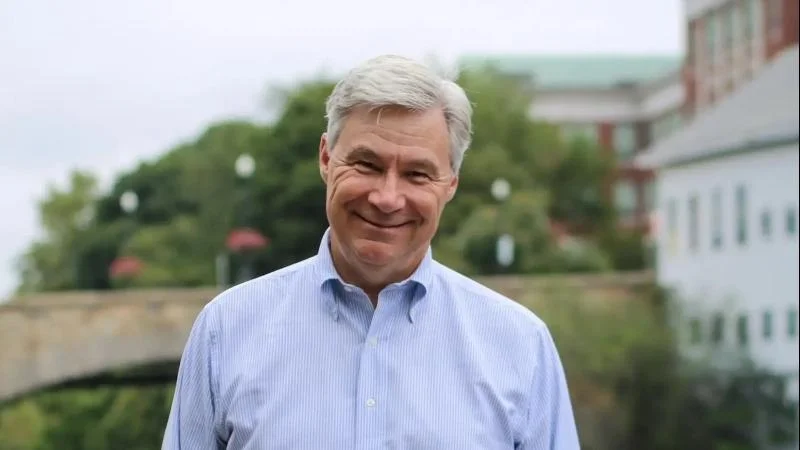
Senator Sheldon Whitehouse, the Ranking Member of the U.S. Senate Environment and Public Works Committee, delivered an opening statement at a bipartisan hearing focused on federal environmental review and permitting processes.
Whitehouse addressed concerns about ongoing challenges in achieving bipartisan permitting reform. He pointed to actions by the Trump administration that he described as arbitrary and inconsistent, particularly regarding renewable energy projects such as offshore wind developments. He referenced an executive order that declared an energy emergency but excluded solar and wind from its definition of energy.
He cited the stop-work order issued for the Empire Wind project off New York, which was lifted after state officials agreed to advance pipeline capacity. Whitehouse also mentioned another halt affecting Revolution Wind off Rhode Island, a project nearly complete with significant investment. The justification for this action was national security concerns, but according to Whitehouse, "That order was instantly thrown out in court as 'arbitrary and capricious,' in part because the Trump administration had been making the opposite arguments, about that same project, in the same courthouse, just weeks earlier."
He quoted warnings from New England’s grid operator about how unpredictable risks threaten investments and could undermine reliability and economic stability: “Unpredictable risks and threats to resources … that have made significant capital investments, secured necessary permits, and are close to completion will stifle future investments, increase costs to consumers, and undermine the power grid’s reliability and the region’s economy now and in the future.”
Whitehouse criticized new layers of political review imposed on solar and wind projects by federal agencies under Interior Secretary leadership. He noted only one solar project has received approval since these changes.
He also addressed what he called a "made-up" metric prioritizing fossil fuels over renewables adopted by several federal agencies.
According to Whitehouse, even after courts ruled against further stop-work orders based on national security pretexts—“That’s been reviewed now by four federal judges, and the administration went 0 for 4. Not one judge believed them”—the executive branch continued to act unpredictably.
Whitehouse accused Energy and Interior secretaries of making false public statements about cost impacts from renewable projects: “All along, the Energy and Interior secretaries were lying non-stop that these projects would raise costs. That is demonstrably false... Court filings and affidavits asserted hundreds of millions in consumer cost savings that the administration could not deny in court — but they kept lying in public.”
Due to these developments, Senators Whitehouse and Heinrich have paused negotiations on permitting reform legislation. He clarified his criticism is directed at executive branch actions rather than Republican colleagues: “Let me be clear. We find no fault with Senate Republicans... This is not Democrat versus Republican. This is legislative versus executive...”
Whitehouse concluded by emphasizing his continued support for bipartisan reform but insisted reforms must be implemented faithfully: “But it makes no sense to pass a bipartisan permitting reform that gets illegally butchered by a lawless executive branch... The responsibility for resuscitating permitting reform rests now upon the executive branch, upon credible confidence that the nonsense will stop.”
He encouraged stakeholders seeking affordable clean energy or concerned about unpredictable regulatory action to advocate for more consistent administrative practices.
The hearing continues efforts within Congress to address longstanding issues with federal environmental reviews while highlighting ongoing tensions between legislative intent and executive implementation.