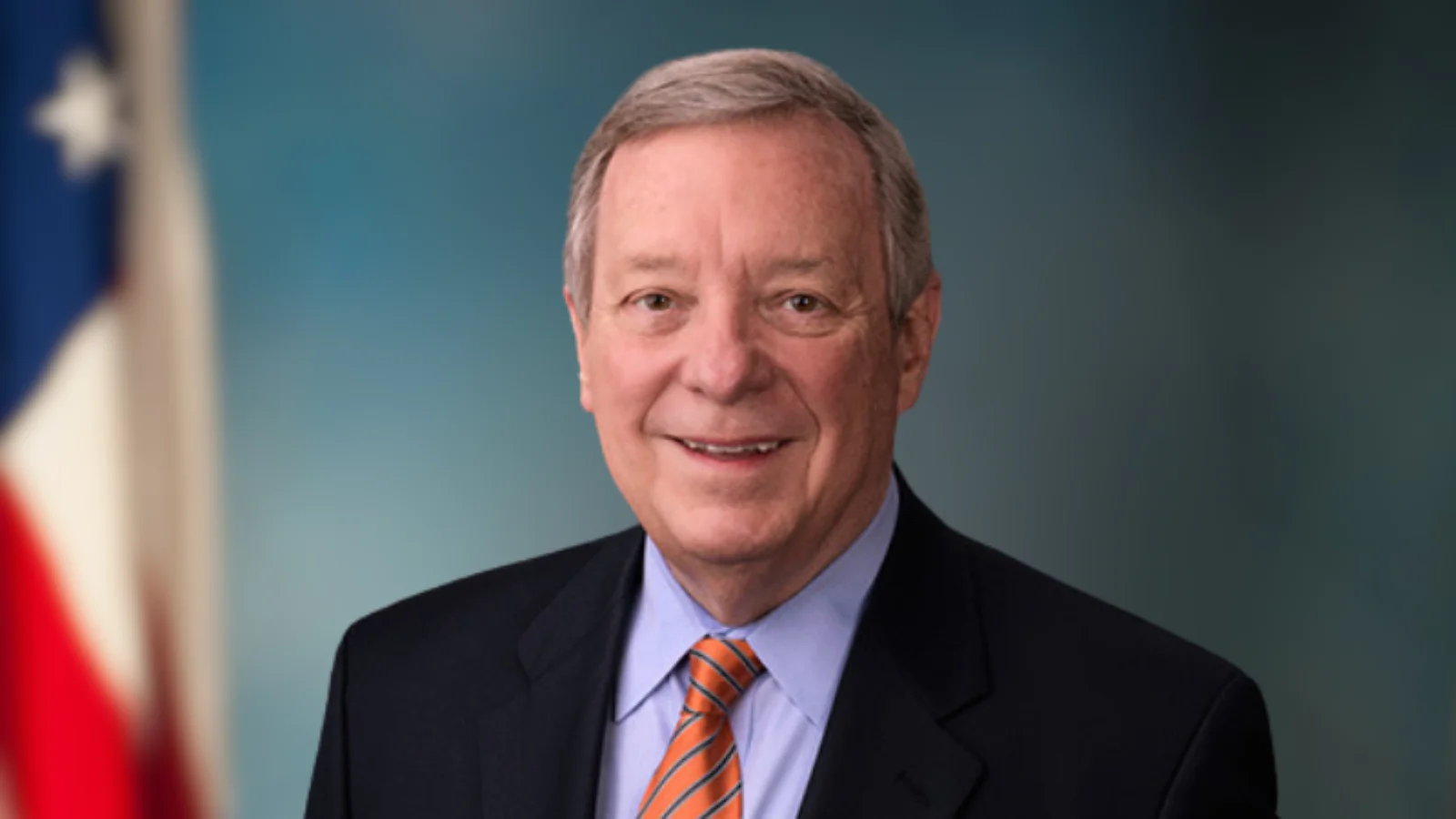
U.S. Senate Democratic Whip Dick Durbin (D-IL), the Ranking Member of the Senate Judiciary Committee, questioned witnesses during a hearing on the Foreign Intelligence Surveillance Act (FISA) and executive accountability. The session took place as Section 702 of FISA approaches its expiration in less than three months.
Durbin began by raising concerns about recent Department of Homeland Security immigration operations in cities such as Chicago and Minneapolis. He criticized these actions for lacking warrants and referenced public unease regarding warrantless searches. “This issue [FISA] is timely not just because of this Section [702] but because of current American awareness of the Fourth Amendment to the Constitution… We are talking about situations in Chicago and Minneapolis where warrantless searches led to helicopters landing on the roof of apartment buildings and people crashing down the front doors of homes without a warrant. It appears Americans don’t care for that any more than they did at the time of the British controlling this country. It appears people want to know by what right are you doing this to me and that is a legitimate question,” said Durbin.
During his questioning, Durbin asked Elizabeth Goitein, Senior Director at the Brennan Center for Justice, about whether it would be feasible to require warrants for searches involving U.S. persons under FISA. He cited reports from intelligence agencies indicating a significant drop in FBI warrantless searches: “The number of such FBI searches has reportedly fallen from nearly three million in 2021 to about 5,500 in 2024. Is that what you understand?”
Goitein clarified that while she did not have figures for 2024, there were 57,000 such searches in 2023, with around half of the decrease due to changes in how queries were counted starting in 2022. She added, “We also know around 50 percent of the drop can be attributed to a change in the way the government counted queries which happened in 2022.”
Durbin further noted that less than two percent of these searches produce results: “By my count, that would mean requiring the FBI to get a court order just over 100 times a year—far fewer than the number of court orders they already obtain every year under other FISA authorities is that correct?”
Goitein responded, “All of the reform proposals under serious consideration do not kick in until after a search has been run and a communication has been identified. The warrant would only be required in those cases, which is two percent. If there were 5,000 queries in 2024, that would be a little over 100 warrant applications.”
“That seems to be not an unreasonable expectation on the part of people who are mindful of this Fourth Amendment,” Durbin said.
Goitein agreed with this assessment.
Durbin then turned his questions to Adam Klein, Director at the Strauss Center for International Security and Law at University of Texas at Austin, focusing on whether obtaining warrants for more than 100 cases annually posed challenges under Section 702 or conflicted with Fourth Amendment protections. He asked Klein: “You talk about your reverences for the Fourth Amendment in the courses you teach. Why would asking the agencies to go for a warrant for more than 100 cases be a hardship?”
Klein replied: “The issue is that in the most important cases where the query is exceptionally valuable… you do not know there is a worrying connection until you run the query.” He explained some queries might prove crucial only after being conducted: “you will not get a court order unless you realize the information is there.”
When Durbin followed up—“You believe current rules don’t allow that to happen?”—Klein answered: “Current rules do not require a court order.” He added that existing regulations could result in fewer queries.
Asked for her perspective on Klein’s comments, Goitein said: “The fact that the government is conducting thousands of searches of Americans’ private communications every year on just a hunch is exactly why we need a warrant requirement. The purpose of warrants is to prohibit exactly those kinds of fishing expeditions. That is the balance that the Framers struck.”
Senators Dick Durbin and Mike Lee (R-UT) previously introduced bipartisan legislation known as The Security and Freedom Enhancement (SAFE) Act aimed at reauthorizing Section 702 while adding safeguards against unwarranted surveillance.