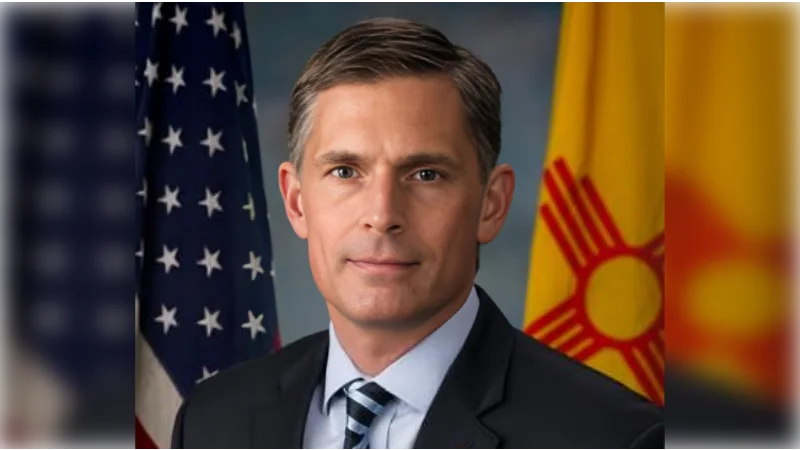
Last week, U.S. Senator Martin Heinrich of New Mexico, who serves as Ranking Member of the Senate Energy and Natural Resources Committee, convened a roundtable to address the impact of Trump Administration policies on American electricity bills. The event brought together Democratic members of the committee, other senators, local officials, union leaders, business owners, and advocates for electrification and efficiency.
According to Senator Heinrich, "President Trump said he would cut electricity prices in half, but electricity prices have risen 13% nationwide since he took office over a year just over a year ago. Instead of saving money, hard-working Americans around the country, and certainly in my home state of New Mexico, are wondering how they're even going to keep the lights on and the heat running this year. Simultaneously, energy demand is growing across the country at a rate we have not seen in recent history."
Heinrich added that current policies are hindering progress: "At a time when we need the cheapest electrons on the grid, the President is taking every opportunity to stop electrons from reaching the grid altogether. The bottom line is that the Trump Administration is failing the American people."
Other senators participating included Sheldon Whitehouse (D-R.I.), Catherine Cortez Masto (D-Nev.), Alex Padilla (D-Calif.), Angus King (I-Maine), Peter Welch (D-Vt.), Mazie Hirono (D-Hawaii), Jack Reed (D-R.I.), and Brian Schatz (D-Hawaii). They were joined by Alfonso “Fonze” Martinez from IBEW Local Union 611; Patrick Crowley of Rhode Island AFL-CIO; Shawyn Patterson-Howard, Mayor of Mt. Vernon, New York; Mark Wolfe from National Energy Assistance Directors Association; Paula Glover from Alliance to Save Energy; Ari Matusiak from Rewiring America; and Scott Libby of Royal River Heat Pumps.
Alfonso “Fonze” Martinez described how project cancellations have affected workers: "Already, my local union has seen the Kit Carson battery storage project in Taos canceled by this Administration’s Department of Energy, putting over 60 of my members out of work, as well as millions of dollars for the PNM virtual power plant project being frozen for purely political reasons. What this means for our local on top of putting folks directly out of work, is that a steady pipeline of highly skilled workers can’t be built without project certainty... The jobs lost and opportunities lost represent real cost to the IBEW, but they will also hurt all families in New Mexico."
Patrick Crowley spoke about challenges facing Rhode Island workers: "I represent 80,000 working-class Rhode Islanders, including many of whom have been hurt by federal actions against job-creating clean energy projects like the 704-megawatt Revolution Wind. While I'm happy to say my members are back to work, I'm afraid the damage has been done. Working-class families in Rhode Island are struggling with expensive, and rising energy bills..."
Mayor Shawyn Patterson-Howard highlighted difficulties for residents: "Energy costs are devastating families. Electricity and gas prices in Westchester are amongst the highest... Spiking energy costs force impossible choices... Energy price stability isn't just a utility issue; it ripples throughout our local economy and strengthens families..."
Mark Wolfe noted an increase in utility shut-offs: "Up to 4 million households faced utility shut-offs in 2025, nearly half a million more than in 2024. Low and moderate-income families now spend six to 10% of their income on energy..."
Paula Glover discussed growing demand: "Across the country, utilities are facing rapid low growth driven by data centers, AI, electrification... Demand is rising much faster than new generation and transmission can be built..."
Ari Matusiak pointed out potential solutions involving household energy production: "We're not building enough new power or bringing it online... It turns out that 50 to 100% of the energy that these data centers need can be furnished by households..."
Scott Libby shared his perspective as a small business owner: "I've built a company with close to 40 employees representing 40 families... With the loss of the tax credit we've seen adoption go down... But this is not a time to retreat. As we work to reduce electricity costs we should double down on efficiency and electrification."
The roundtable focused on concerns about higher consumer costs due to delays or cancellations in clean energy projects and called for renewed efforts toward affordable energy solutions.