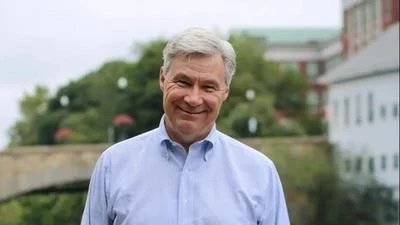
Senator Sheldon Whitehouse, the Ranking Member of the Senate Committee on Environment and Public Works (EPW), is leading an investigation with 31 other senators into a recent Environmental Protection Agency (EPA) policy change. The new EPA decision stops counting health benefits in cost-benefit analyses for Clean Air Act rules that regulate pollutants such as fine particulate matter (PM2.5) and ozone.
In a letter to EPA Administrator Zeldin, the senators criticized the move: “EPA’s new policy is irrational. Even where health benefits are ‘uncertain’, what is certain is that they are not zero. It will lead to perverse outcomes in which EPA will reject actions that would impose relatively minor costs on polluting industries while resulting in massive benefits to public health – including in saved lives. It is contrary to Congress’s intent and directive as spelled out in the Clean Air Act. It is legally flawed. The only beneficiaries will be polluting industries, many of which are among President Trump’s largest donors,” wrote the Senators.
The senators argue that despite claims from the EPA about uncertainty in quantifying PM2.5 and ozone benefits, federal agencies have long used established methods to assess both costs and benefits related to human health under Executive Order 12866 during rulemaking processes.
They also warn that by considering only industry compliance costs—and not impacts on human life—the agency could increase Americans’ health risks and result in billions more spent on healthcare. According to their analysis, if this approach is applied when reconsidering national PM2.5 standards, it could cost Americans “between $22 and $46 billion in avoided morbidities and premature deaths in the year 2032,” while industry would save $590 million—“between one and two one-hundredths of the estimated health benefit value.” The senators added that “EPA has frequently overestimated cost to industry when promulgating regulations in the past,” but even if current estimates hold true, “the expense of forgoing the $22 to $46 billion benefit would burden Americans across the country in lives lost, more frequent and severe illnesses, missed school days and lost labor productivity, [while] the $590 million in savings would go mostly into the pockets of a small group of Trump’s fossil fuel donors.”
The letter also notes that this shift runs counter to EPA’s core responsibility under federal law—to protect public health—as well as previous commitments made by Administrator Zeldin during his confirmation hearing: “the goal, the end state of all the conversations that we might have, any regulations that might get passed, any laws that might get passed by Congress” is to “have the cleanest, healthiest air, [and] drinking water.” The senators say Administrator Zeldin’s current actions contradict these earlier statements.
“That EPA may no longer monetize health benefits when setting new clean air standards does not mean that those health benefits don’t exist—it just means that [EPA] will ignore them and reject safer standards, in favor of protecting corporate interests,” concluded the Senators.
The senators suggest this policy could open up looser controls on other pollutants—including those from coal-burning power plants.
Besides Senator Whitehouse, signatories include Democratic Leader Chuck Schumer (D-NY), Angela Alsobrooks (D-MD), Michael Bennet (D-CO), Richard Blumenthal (D-CT), Lisa Blunt Rochester (D-DE), Cory Booker (D-NJ), Tammy Duckworth (D-IL), Dick Durbin (D-IL), Ruben Gallego (D-AZ), Kirsten Gillibrand (D-NY), Martin Heinrich (D-NM), Mazie Hirono (D-HI), Mark Kelly (D-AZ), Angus King Jr. (I-ME), Amy Klobuchar (D-MN), Ben Ray Luján (D-NM), Ed Markey (D-MA), Jeff Merkley (D-OR), Patty Murray (D-WA), Alex Padilla (D-CA), Jack Reed (D-RI), Bernie Sanders (I-VT), Brian Schatz (D-HI), Adam Schiff (D-CA), Jeanne Shaheen (D-NH), Chris Van Hollen (D-MD), Raphael Warnock (D-GA), Elizabeth Warren(D-MA ), Peter Welch(D-VT ), Ron Wyden(D-OR ).
Whitehouse and Schumer previously led opposition efforts against EPA rollbacks on power plant pollution standards as well as attempts to reverse findings linking greenhouse gases with climate risks—a repeal finalized February 12 described by both senators as a “shameful abdication” harming Americans’ well-being.
The group has requested documents relating to this decision—including analyses supporting or contesting it—by February 24.
According to its official website, the Senate Environment and Public Works Committee oversees federal programs affecting environmental quality, natural resources management, infrastructure maintenance nationwide and collaborates through subcommittees focused on issues like clean air regulation.