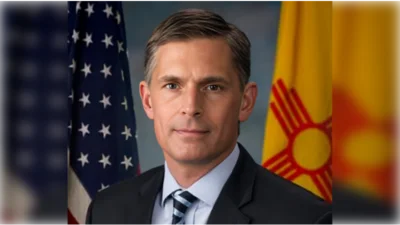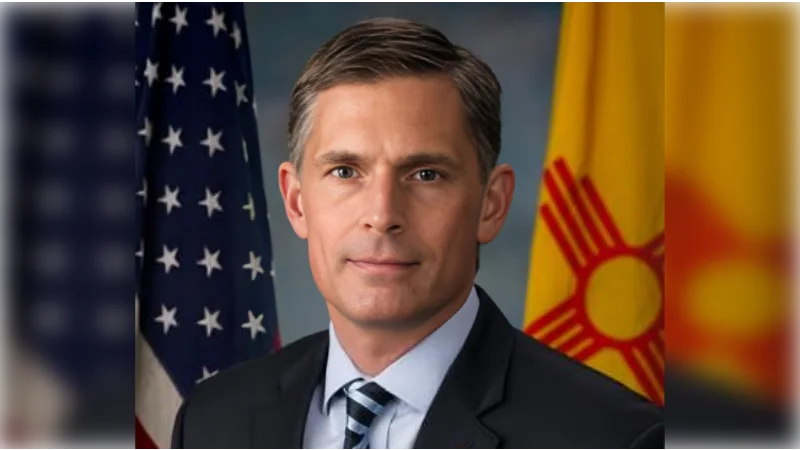
During a recent hearing of the U.S. Senate Energy and Natural Resources Public Lands, Forests, and Mining Subcommittee, Senator Martin Heinrich (D-N.M.), Ranking Member of the full Committee, questioned federal officials about staffing levels, funding for wildfire preparedness, and a proposed gravel mine in Placitas, New Mexico.
Senator Heinrich pressed Christopher French, Associate Chief of the U.S. Forest Service, on how cuts made during the Trump Administration have affected the agency’s ability to manage public lands and respond to wildfires. Heinrich said: “Mr. French, we've seen a pretty substantial cut in the workforce in New Mexico, in the Forest Service. We've seen that on the Santa Fe National Forest,we've seen it on the Carson National Forest, the Cibola, the Lincoln, the Gila. It's been felt across the system from issues like trail maintenance to processing permits for outfitter guides, to wildfire preparedness. The bills that we're talking about today direct your agency to do a number of things, to take actions and undertake new endeavors and new policies.All of which require an adequate workforce. How many National Forest System staff would actually be needed to fulfill your mission? All of the things that the Congress has tasked the National Forest System to do and to properly manage the roughly 193 million acres of land that the U.S. Forest Service manages?”
French acknowledged challenges related to insufficient funding and staffing: “So, I mean, the reality is if you look at the requirements of statutes of what we're told and asked to accomplish there, the needs for funding and staffing far exceed the requirements that are placed on us to manage those to standard. We manage the largest trail system in the country—165,000 miles of trails—and yet,the staffing that we have and budgets that we have,we struggle to maintain up to a third of it a year...Today,we're announcing 2,000 summer hires,recreation hires,to assist us in overcoming that work.We've been in a place of getting our workforce to a more sustainable level,to the budgets we have.But we do,we have done that work.We can certainly share it with you.I'm not prepared today to give you.”
Heinrich also addressed firefighter compensation: “Do we pay our firefighters enough?” French replied: “No.” He elaborated: “…When I look at what we asked them to do and watching over the last 20 years our fire seasons becoming larger and larger putting more demands on them…when I look at what is being compensated at state levels,I think there's work to do there.”
The senator then questioned Jon Raby,Bureau of Land Management (BLM) Nevada State Director,on whether current BLM staffing is sufficient given its responsibility for managing 245 million acres nationwide.Raby stated:“In Bureau of Land Management,we have an organization about 9,000 employees…We receive about $5.75 per acre…We've always been very focused again on our mission delivery…and ensuring organizational efficiency…while again,we may not have always received what we may have desired…we are very focused on what we do have…and then set our priorities accordingly.”
Heinrich challenged BLM’s position regarding community opposition toward establishing a gravel mine within residential areas near Placitas.“The parcels identified for withdrawal in Buffalo Tract Protection Act make up roughly over 4,000 acres.One concern is they're scattered through residential neighborhoods.So,the impacts...would be felt pretty acutely.And residents are rightly worried about health impacts,noises,and disruption...there's literally a gravel mine just down road that's very successful because it's not in middle of residential community.Do you think suburban neighborhood is appropriate place for gravel mine?”
Raby responded,“When we look at proposal for mineral withdrawals…it can preclude opportunities…and options for responsible development…” Heinrich interrupted,“How is it responsible...very noisy...industrial activity in middle suburban neighborhood?...I don't understand ‘responsible’ part...” Raby cited environmental review processes; however Heinrich pointed out widespread local opposition.“Your position…the BLM position has literally no community support.Do you listen before making decision like that?” Raby answered,“Of course,we listen…our district managers absolutely are engaged with community…but they also account for national policy direction.We have declared National Energy Emergency which by reference includes Mineral Emergency.” When pressed further,Raby said producing gravel was considered supporting mineral resources.Heinrich countered by noting existing supply nearby.
Heinrich concluded,“My point is your policy here is completely disconnected from local community…when there's federal policy dictated from Washington,D.C.,that's completely disconnected.This case…the Administration & BLM are ignoring local community…I want entered into record all community groups—from Tribes,country,municipality,to neighborhood association—that this would impact,their views on Buffalo Tract Protection Act.” Senator Catherine Cortez Masto confirmed these statements would be entered into record.
A list detailing endorsements and statements supporting Buffalo Tract Protection Act was referenced during proceedings.