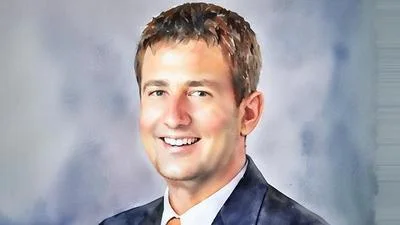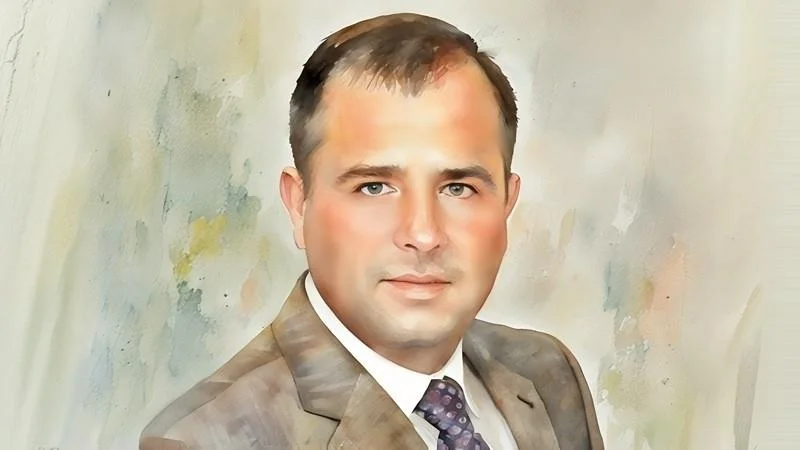
Four years after Russia launched its full-scale invasion, Ukraine remains under relentless assault. Pavlo Unguryan of the Ukraine Rebuilding Alliance argues that the war represents a struggle between Western Christian civilization and what he calls a revanchist, authoritarian regime determined to rebuild the Russian empire.
Unguryan is a former member of the Ukrainian parliament and co-founded the NGO, which he chairs. He is also vice president of the Association of Ukrainian Regions and coordinator of the Christian platform of the Ukrainian American Partnership. Speaking from Ukraine amid ongoing drone attacks, he describes the daily strain of war.
“Sometimes in one night it can be 300, 400, 500 drones and missiles in one city,” he says. Strikes have damaged “heat stations, electricity stations, water stations, and transition stations for energy.” Basic services often depend on generators. “I was just driving around the city to find a place which has a generator,” he says. “Please pray for us. This is our life.”
Unguryan sees Ukraine’s survival as providential. “It looks like small boy David against Goliath,” he says, describing Russia as a vast military power. “First of all, it is a great miracle from God.” He recounts a storm in the Black Sea during the early days of the invasion that disrupted a planned Russian naval assault on Odessa. “God created a big storm in the Black Sea,” he says. When Russian ships returned weeks later, Ukrainian forces were prepared.
The roots of the conflict, he argues, stretch back decades. Ukraine surrendered what was then the world’s third-largest nuclear arsenal under the 1994 Budapest Memorandum in exchange for security assurances from the United States, the United Kingdom, and Russia. “It was a mistake,” he says, asserting that Kyiv relied on commitments that Moscow ultimately violated. He also criticizes Western responses to Russia’s 2014 annexation of Crimea. “Putin understood how the West is weak,” he says, claiming this led to Russia’s further aggression.
Energy politics played a role as well. Unguryan points to decisions surrounding the Nord Stream 2 pipeline and what he describes as Europe’s dependence on Russian gas. This allowed Russia “to corrupt Europe through…energy,” he says.
But Unguryan sees a spiritual dimension. Ukraine, he contends, represents “the spiritual heart” of Eastern Christianity, with Kyiv’s Christian heritage stretching back more than a millennium. He accuses Moscow of weaponizing religion. “Russian Orthodox Church… blessed the army and Putin’s regime for a holy war against the West,” he says, referencing declarations by church leaders aligned with the Kremlin. He argues that Ukraine defends religious freedom, not persecution. “We need to protect religious freedom,” he says, while preventing intelligence operations disguised as religious institutions.
Peace, in his view, must rest on deterrence. “Peace without justice… it is not a real true peace,” he says. He endorses what he calls “peace through strength,” invoking the Reagan-era formulation. Ukraine seeks an end to the war, he says, but not at the cost of sovereignty or security. “We cannot play dirty games with criminals,” he says.
Unguryan outlines a three-part vision for rebuilding. National defense comes first. “Right now it’s army number-one in the European continent,” he says of Ukraine’s battle-tested forces, highlighting the country’s drone production and military innovation. Economic reform is second. Ukraine possesses “amazing land… rare earth minerals… fresh water and seaports,” he says, but requires rule of law and investment-friendly policies. Finally, he emphasizes moral foundations. “We cannot do [anything] without our values,” he says, citing faith, family, and patriotism as pillars of renewal.
Unguryan acknowledges that Ukraine has suffered from corruption and institutional weaknesses, which he says are rooted in Soviet legacy. “This war [is] also against this tradition and bad heritage,” he says. He believes Ukraine can emerge stronger by aligning security, economic reform, and spiritual revival.
“We would like to be a conservative movement for the country,” he says, envisioning a sovereign Ukraine anchored in Western partnership. Survival alone, he suggests, is not the ultimate goal. Renewal is the goal.