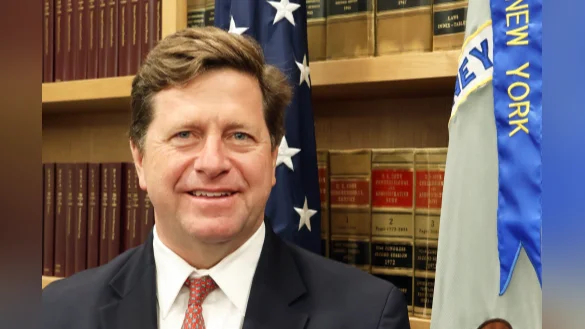
Jay Clayton, U.S. Attorney for the Southern District of New York | Department of Justice
A financial advisor has been found guilty of defrauding three professional basketball players out of more than $5 million. Darryl Cohen, a registered investment adviser, was convicted following a five-week jury trial before U.S. District Judge Vernon S. Broderick in New York.
“Financial Advisor Darryl Cohen built trust with successful pro athletes—then betrayed it, stealing their money to fund personal luxuries, including a state-of-the-art gym in his own backyard,” said U.S. Attorney Jay Clayton. “New Yorkers deserve honest financial advice—not advisors who scheme to steal clients’ funds, rather than protect their financial interests—and this Office is committed to removing bad actors from our markets.”
According to court documents and evidence presented at trial, Cohen defrauded former clients Chandler Parsons, Courtney Lee, and Jrue Holiday between 2017 and 2020. Working with accountant Brian Gilder, Cohen convinced the athletes to buy viatical life insurance policies at significant markups without disclosing that Gilder controlled the law firm selling the policies. The markups ranged from 222% to 310%, resulting in approximately $4.5 million in profit for the law firm.
Cohen used proceeds from these sales for personal expenses such as home renovations and pool work totaling about $178,462, paid off around $67,500 in credit card debt, and transferred roughly $200,000 to an individual with whom he had a romantic relationship.
Additionally, Cohen arranged for $500,000 to be transferred from Parsons' and Lee's accounts as supposed donations to Beast Basketball, a non-profit organization. Of those funds, about $238,000 was used by Cohen to build an athletic gym at his home. The athletes had not authorized these transfers.
When questioned by Parsons about the donation transfers, Cohen told him via text message that his money had “[h]elped a lot of future prospects and a lot of underprivileged kids.” However, he did not disclose that much of the donation funded construction on his property.
In another instance detailed during the trial, Cohen directed over $328,000 from Parsons’ account through intermediaries to repay Nyjer Morgan—a former professional baseball player and dissatisfied client who had demanded repayment after raising concerns about investments made on his behalf. Parsons did not authorize this use of his funds.
Cohen was convicted of one count of wire fraud—which carries up to 20 years in prison—and one count of investment adviser fraud—with a maximum sentence of five years. Sentencing will be determined by Judge Broderick at a later date.
U.S. Attorney Jay Clayton praised the Federal Bureau of Investigation’s work on the case and thanked several other U.S. Attorney’s Offices as well as the Securities and Exchange Commission for their assistance.
The prosecution is being handled by Assistant U.S. Attorneys Kevin Mead, Brandon Thompson, and William Kinder from the Complex Frauds and Cybercrime Unit.