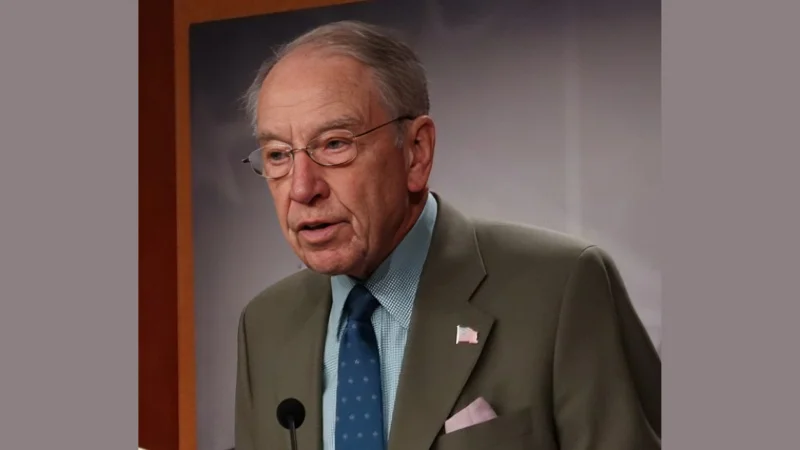
The Senate Judiciary Committee held a hearing to discuss the rise of online threats against children, focusing on sextortion and violent online criminal groups. Chairman Chuck Grassley (R-Iowa) and Ranking Member Dick Durbin (D-Ill.) introduced three bipartisan bills aimed at updating federal sentencing guidelines, targeting criminal networks, and addressing sextortion threats.
During the hearing, witnesses emphasized the urgent need for legislative action. Tamia Woods, co-founder of the Do It For James Foundation, stressed the importance of making sextortion illegal under federal law. "We have to make sure that, not only do our children see that we have their back on these issues, but we have to make sure that they know there are resources and laws that back them up," Woods said. She added, "People need to be held accountable on top of that. They need to know that they shouldn’t be comfortable with doing the things that they’re doing. Right now they’re comfortable, and you see more and more people being victimized because of that."
Lauren Coffren, Executive Director of the National Center for Missing & Exploited Children, described how violent online groups like "764" operate. Coffren stated, "Sadistic online exploitation, violent online groups… most often they’re motivated purely by chaos. Their goal is to be able to weaponize our nation’s children to create terror… Children may be looking for solace, for comfort, for advice in online platforms and spaces where they can find a community. Unfortunately, these offenders are infiltrating and targeting those communities." She continued, "The imagery, the videos, the chats that we are seeing and reading are some of the most graphic that I have ever seen in my 20-year history. We are hearing from law enforcement out in the field who’ve said that this is the most disturbing content as well. So, you’re talking about seasoned professionals who are really meeting their match with the new and evolving types of exploitation that we’re seeing."
Jessica Lieber Smolar, former Assistant United States Attorney for the Western District of Pennsylvania, discussed gaps in federal law regarding prosecution of these crimes. Smolar explained: "Congress has provided so many important tools to those of us in the field, like mandatory minimums for crimes like receipt and distribution of child pornography or production. [Prosecutors] need those tools in order to properly hold these types of defendants accountable. Right now, when [prosecutors] charge crimes like sextortion or 764 across the country, we all charge them differently… There’s no consistency that allows [prosecutors] to properly address the specific harm that these actors are committing."
Smolar also highlighted challenges with prosecuting offenders based overseas: "In addition, a lot of these actors are overseas. It would be extremely helpful for those of us who want to extradite people here to the United States, to hold them accountable, to have a felony statute that specifically speaks to this harm." She cited an example involving Germany: "I’m familiar with a case where a defendant was in Germany. Germany had a coercion to harm statute, but [the United States] did not. [Germany] was able to charge that 764 offender there, but we could not charge him here. That shouldn’t happen. We should be able to charge these offenders, hold them accountable and deter them from continuing to hurt our children."
The hearing underscored concerns over increasing cases of child exploitation online and called attention to legislative gaps hampering prosecution efforts.