Four years after Russia invaded Ukraine, some Americans believe Ukraine is doomed to fail, and others see the war as a NATO provocation, while Russian propaganda works to distort what is happening on the ground. Steven Moore argues that those narratives collapse when confronted with reality inside Ukraine, where a resilient society, a citizen army, and a determined national identity have held back a far larger aggressor.
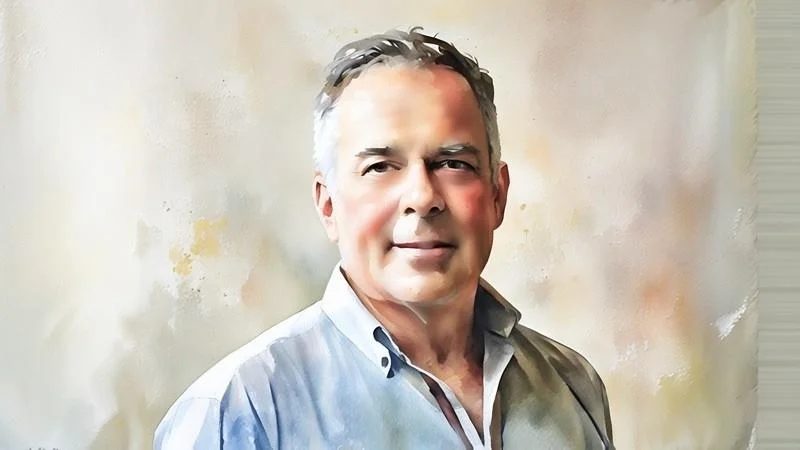
Moore is the founder of the Ukraine Freedom Project. He served as a chief of staff on Capitol Hill and first developed an interest in Eastern Europe while working in Russia in 1996 as part of a small team of American political consultants advising Boris Yeltsin’s reelection campaign. He later built ties to Ukraine through professional contacts in the tech sector and by living there in 2018 and 2019.
When Russia launched its full-scale invasion in February 2022, Moore responded almost immediately. “Day five, March 1st, 2022,” he says, describing when he arrived in Ukraine. During the first weeks, he focused on helping friends and civilians escape danger zones. “We got about 110 people to safety,” he says, including residents fleeing Kharkiv and other front-line areas. He expected, like many observers, that Russia might overrun the country quickly. Instead, Ukraine held.
Moore rejects the claim that Russia is somehow winning in any meaningful strategic sense. “If 2007 rolled around and Bush had been in Iraq for four years and he addressed the American people and said, ‘Well, we’ve been here for four years, we’ve got 20% of the country and we’ve lost 1.2 million soldiers,’ who would view that as a victory?” he asks. That comparison, he argues, helps clarify just how costly and incomplete Russia’s campaign has been.
A major part of his work now involves countering disinformation directed at American conservatives. “We push back on Russian disinformation and we try to get good information to American conservatives, American Christians, Republicans on Capitol Hill,” Moore says. He contends that false claims about Ukraine persecuting Christians have gained traction because they contain “a kernel of truth” twisted into propaganda. The reality, he says, is that Ukraine is confronting a Russian Orthodox network that functions as an intelligence and influence apparatus for the Kremlin.
He draws a sharp distinction between genuine religious freedom and what Russia has built. “The branch of the Russian Orthodox Church inside Ukraine is essentially a spy network for the Kremlin,” he says. He notes that clergy have faced prosecution for actions including “helping the Russians target artillery, for storing Russian weapons, for preaching surrender.” That does not amount to anti-Christian persecution, he argues. “It’s not a church,” he says. “It’s a spy network.”
Moore says the Kremlin’s religious dimension is darker still in occupied territories. “They’ve killed 80 pastors and priests who are not Russian Orthodox,” he says. “They’ve shut down every church in occupied Ukraine that is not controlled by the Kremlin.” He also recounts the story of a Ukrainian evangelical named Victor, who was detained by Russian forces and tortured. According to Moore, a Russian Orthodox priest participated while trying to “cast demons out of him for being an evangelical Christian.”
He also pushes back against the idea that Ukraine is destined to become a failed state. “If I could magically transport you to Kyiv right now, you would have trouble figuring out if there’s a war going on,” he says, while acknowledging the severe damage done to the country’s electrical and heating infrastructure. Ukraine, he says, still possesses strong human capital, entrepreneurial energy, and technical expertise. “They’ve got an amazing group of engineers, entrepreneurs,” he says. “All the really big technological advancement in the Soviet Union came out of Ukraine.”
That capacity now shows up on the battlefield. “Seventy percent of the weapons used by Ukraine right now were built by Ukraine,” Moore says. He points to drone warfare and domestic military innovation as evidence that the country is adapting under pressure rather than collapsing under it.
The West, he argues, still has not fully absorbed what Ukraine has already demonstrated. “This is a citizen army,” he says. “And they’re amazing.”