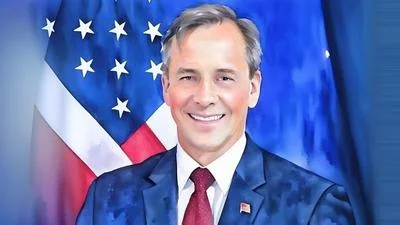
Concerns about China’s influence are shifting from Washington to state and local debates over investment, security, and supply chains. Former U.S. ambassador Joseph Cella says gaps in awareness at the grassroots level leave communities vulnerable.
Cella served as U.S. ambassador to Fiji and several Pacific territories from 2019 to 2021. He founded the Pontifex Group, the National Catholic Prayer Breakfast, and co-founded the Michigan China Economic and Security Review Group. He now leads the Secure Our States Coalition, a national effort focused on what he describes as grassroots vulnerabilities in addressing China-related risks.
Cella says the coalition emerged from firsthand experience in Michigan. “It was proof of concept… nobody was really doing anything,” he says. “There was a gap in terms of security, of policy, of awareness from the grassroots level.” He describes the effort as a response to “the information gap, the security gap, and the awareness gap,” which he says persists across states.
That gap, according to him, begins with everyday citizens. “The citizens are kind of glassy eyed, just living life… not particularly engaged as to what is surrounding them,” he says. “Many will say that couldn’t be the case” and that “there couldn’t be a threat.” He argues that engagement must start locally and extend upward. “It would start with citizens… and certainly the local electeds, all the way up.”
Cella frames the coalition as a nationwide effort. “It really is a 50-state focus… whole of society, whole of government,” he says. He adds that the group aims to “identify, expose, and counter the China threat” through a “citizen led, citizen focused basis.”
Economic activity masks deeper concerns, he says. “Seemingly benign business deals, more likely than not, are not benign,” he says. He argues that foreign actors “take advantage of our open system” and “will often not hesitate to pull out their wallet… to sway votes or inspire people in malign ways.”
Those tactics extend across multiple sectors. “They’re using foreign direct investments, tax credits, partnerships, lobbyists,” he says. “Part of our open system… really used for malign ends.” He adds that the motivation is often straightforward. “It is a very transactional engagement. It is all about the almighty dollar.”
Cella says policymakers sometimes fail to recognize the stakes. “Even those elected officials who have taken the oath… they kind of forget that, unfortunately,” he says. He argues that stronger scrutiny and shared standards are needed. “There almost has to be an ethos… that they ask the hard questions.”
State-level action, according to him, is beginning to shift. “The states are taking notice,” he says, pointing to legislative efforts and growing bipartisan cooperation. He describes the process as gradual. “It will take time to get focus, get their messaging reconciled, [and get] people on board.”
Public opinion can move faster. “There were polls… 80 to 20 against any Michigan taxpayer dollars going towards any of these non-benign deals,” he says. He predicts the issue will expand politically. “This is ripe. We’ll see it on a scale basis in 2026.”
Cella also highlights concerns around technology and infrastructure. “The countries of Poland, Israel, and Britain now have restrictions on Chinese EVs being on or near military bases,” he says. “That’s for a reason.” He warns of potential data risks. “Whether it’s biometric or electronic information… [they could be] vacuumed up and sent wherever.”
He points to future debates over data centers and supply chains. “We ought to be having a conversation in terms of data and the components within these entities,” he says. “Many critical elements are made in China. The importance of that cannot be overstated.”
Despite growing awareness, he says the U.S. is still catching up. “We are playing catch up for a number of years,” he says. “We have profited mightily, however, I think we almost had an anesthetized state not tracking things.”
Cella emphasizes persistence over quick results. “It is just going to take the hammer to keep at it,” he says. “Be persistent in purpose and constancy of mind.”