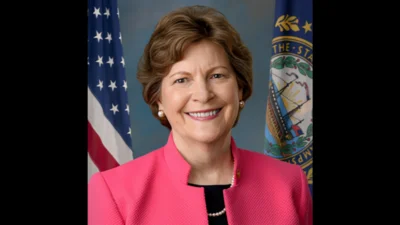
U.S. Senator Maria Cantwell, Ranking Member of the Senate Committee on Commerce, Science and Transportation, raised concerns on the Senate floor regarding a provision added to the National Defense Authorization Act (NDAA) that would allow military aircraft to operate in Washington, D.C. airspace without transmitting their location using ADS-B Out technology. This provision, known as Section 373 of the NDAA, reverses safety measures implemented after a mid-air collision near Ronald Reagan National Airport in January that resulted in 67 fatalities.
“We don't even know who stuck it in,” Sen. Cantwell said about the provision. “People should be asking, who stuck in this language, who's standing by it, who's committed to it, who thinks it's a good idea? Because none of the safety advocates think that it's a good idea. I hope my colleagues will be as outraged as I am over this provision, outraged, along with the families, with the NTSB administrator and help us fight this issue.”
Earlier in the day, Jennifer Homendy, Chair of the National Transportation Safety Board (NTSB), criticized Section 373 in a letter to leaders of congressional armed services committees. She described it as “an unacceptable risk to the flying public.” Families affected by Flight 5342 and others also voiced opposition to retaining this exemption for military flights.
Senator Cantwell joined Chairman Ted Cruz and other aviation subcommittee leaders—Senators Jerry Moran and Tammy Duckworth—in issuing a joint statement: “Almost a year after 67 lives were lost when a military helicopter hit American Airlines flight 5342 over the Potomac River, the NDAA fails to make the skies safer. As drafted, the NDAA protects the status quo, allowing military aircraft to keep flying in DC airspace under different rules and with outdated transmission requirements. This comes as Pentagon data shows a spike in military aircraft accidents since 2020. The families of the victims deserve accountability. The NDAA should be stripped of this new loophole and instead include the ROTOR Act -- a bipartisan bill that closes the dangerous exemption that allows military aircraft to operate in domestic skies without communicating their position. We must act decisively to prevent future tragedies.”
The ROTOR Act was advanced out of committee by Senators Cantwell and Cruz on October 21, 2025; it incorporates provisions from Cantwell’s Safe Operation of Shared Airspace (SOSA) Act introduced earlier that year. The bipartisan legislation seeks to end Department of Defense exemptions from ADS-B Out transmission requirements for most flights near busy airports such as Reagan National Airport.
During her remarks on the Senate floor Sen. Cantwell highlighted concerns from victim families: “Safety that depends on exemptions cannot be the foundation of [a secure] airspace system.” She argued that maintaining such exemptions could make it more difficult for commercial pilots and controllers to detect nearby military training flights.
Cantwell also questioned how Section 373 was inserted into legislation despite opposition from both Senate Commerce Committee members and House counterparts: “I don't even know how this got in the bill…So how is it that this is now in the bill that we all have to respond today?”
She concluded by urging fellow senators to reconsider Section 373: “So Mr. President, I hope my colleagues will be as outraged as I am…outraged along with…the NTSB administrator and help us fight this issue.”